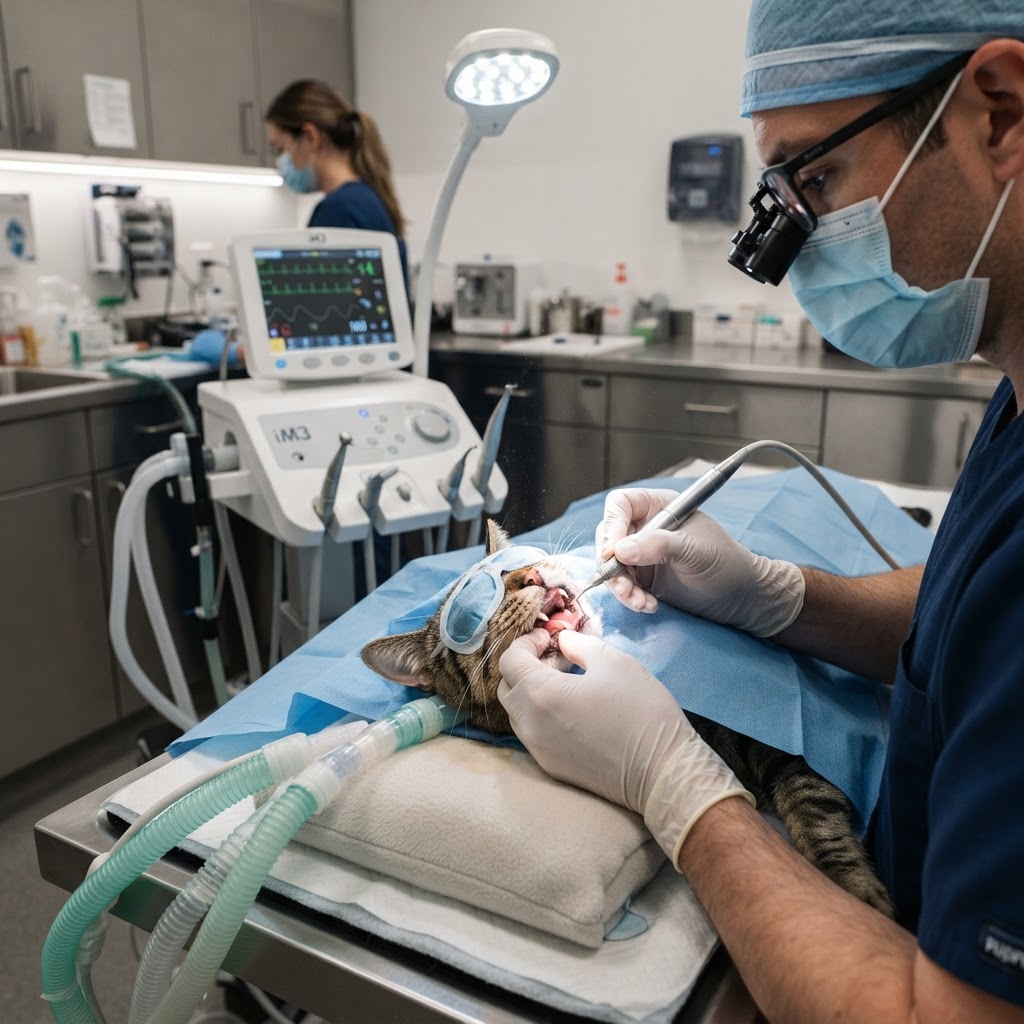
Dental disease is extremely common in cats — by age 4, 50–90% of cats have some form of dental disease. Cats are also uniquely prone to tooth resorption, a painful condition where the body breaks down its own teeth. Tooth extraction is the primary treatment for fractured, infected, or resorbing teeth.
The average cost of a cat tooth extraction is $80 per tooth, with total costs ranging from $300 to $1,300 depending on the number of teeth extracted and whether surgical technique is required.
Cat Tooth Extraction Cost by Tooth Type
| Tooth Type | Cost Per Tooth | Notes |
|---|---|---|
| Incisor (tiny front teeth) | $50–$130 | Small, single root, easiest to remove |
| Premolar | $80–$250 | 1–2 roots, moderate difficulty |
| Canine tooth (fang) | $150–$400 | Long root, requires surgical technique |
| Carnassial tooth (large back tooth) | $200–$500 | 2 roots, largest tooth, requires bone removal |
| Full mouth extraction (all teeth) | $1,000–$3,000 | Severe resorption or stomatitis |
Total Cost Breakdown
| Component | Cost |
|---|---|
| Pre-anesthetic exam | $50–$100 |
| Pre-anesthetic blood work | $80–$200 |
| Dental X-rays (full mouth) | $100–$250 |
| Anesthesia + monitoring | $150–$350 |
| Extraction (per tooth) | $50–$500 |
| Take-home pain medication | $25–$60 |
| Antibiotics (if infection) | $25–$50 |
| Single Tooth Total | $300–$800 |
| Multiple Teeth Total | $500–$1,300+ |
Cat Tooth Resorption — The #1 Reason Cats Need Extractions
Tooth resorption (formerly called feline odontoclastic resorptive lesions or FORLs) affects 30–60% of cats. The body's own cells (odontoclasts) break down the tooth structure, starting at the root and working upward. The cause is unknown, and there is no prevention.
Symptoms: Pain when eating, drooling, dropping food, hiding, weight loss, and prefering soft food.
Treatment: The affected tooth must be extracted — there is no way to save a resorbing tooth. See tooth resorption treatment costs.
Cost by Clinic Type
| Clinic Type | Single Extraction | Multiple Extractions |
|---|---|---|
| General practice vet | $300–$600 | $500–$1,300 |
| Board-certified veterinary dentist | $500–$900 | $800–$2,500 |
| Teaching hospital | $200–$400 | $400–$900 |
| Low-cost clinic | $150–$350 | $300–$700 |
Signs Your Cat Needs a Tooth Extraction
- Dropping food while eating
- Chewing on one side of the mouth only
- Excessive drooling
- Pawing at the mouth
- Bad breath (worse than usual cat breath)
- Red, inflamed gums
- Reluctance to eat or weight loss
- Hiding or behavioral changes (pain)
Frequently Asked Questions
How much does a cat tooth extraction cost?
Cat tooth extraction costs $50 to $130 per tooth for simple extractions, and $150–$500 for complex extractions (canine or carnassial teeth). Total cost including anesthesia, X-rays, and blood work is $300–$800 for one tooth, or $500–$1,300 for multiple teeth. Full mouth extraction costs $1,000–$3,000.
Why does my cat need dental X-rays before extraction?
Cat teeth are small and tooth resorption often occurs below the gum line, invisible to the naked eye. Dental X-rays reveal root health, resorption, and bone loss that determine the extraction technique. Without X-rays, the vet can't know if a tooth needs simple or surgical extraction — or if other teeth are affected.
Does pet insurance cover cat tooth extraction?
Yes, most pet insurance covers cat tooth extraction when medically necessary (resorption, fracture, infection, periodontal disease). Reimbursement is typically 70–90% after your deductible. Routine cleaning may require a wellness add-on.
Can my cat eat without teeth?
Yes. Cats adapt extremely well to having teeth removed. Even cats with full mouth extractions (all teeth removed) can eat dry kibble within 2–3 weeks. Many cats are significantly more comfortable and eat better after painful teeth are extracted.
What is tooth resorption in cats?
Tooth resorption is a painful condition where the body breaks down its own tooth structure. It affects 30–60% of cats and has no known cause or prevention. The only treatment is extraction. See tooth resorption treatment costs.