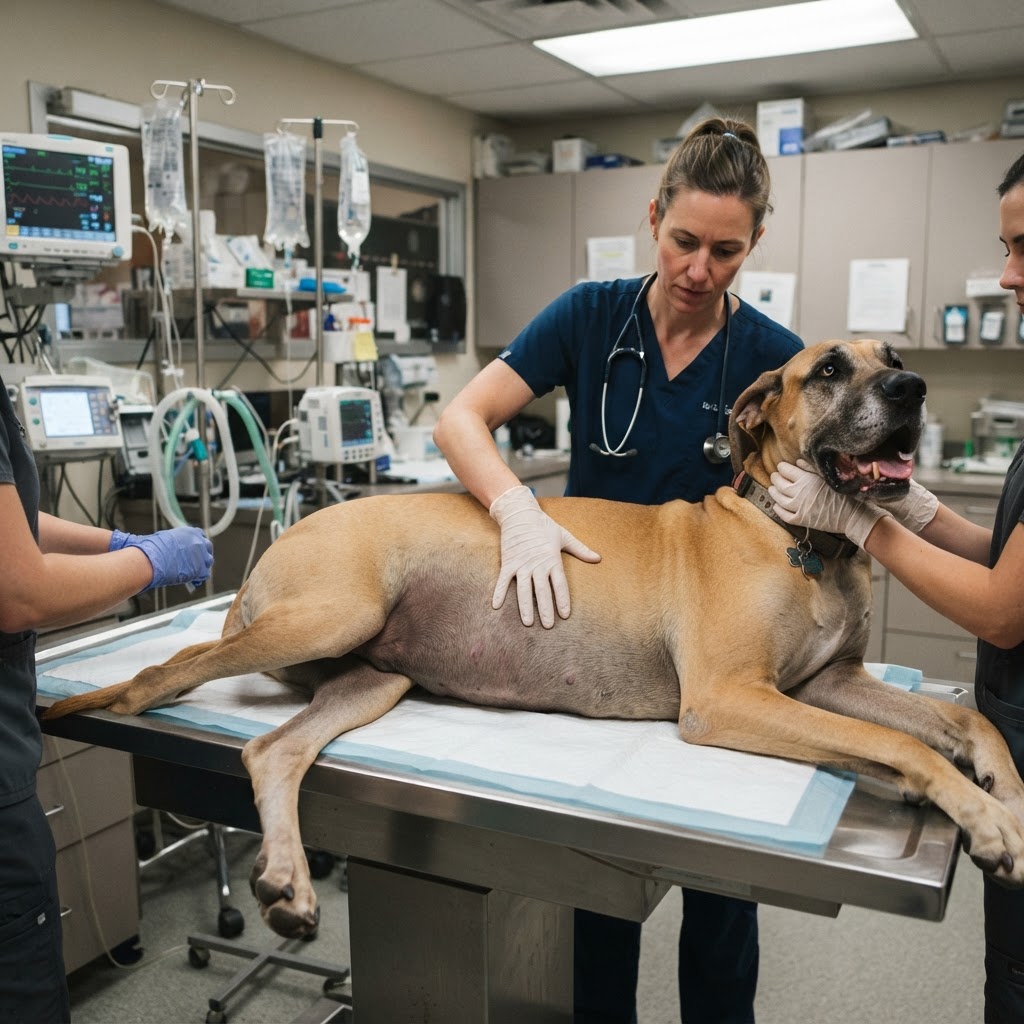
GDV (Gastric Dilatation-Volvulus), commonly known as "bloat," is one of the most life-threatening emergencies in veterinary medicine. The stomach fills with gas and twists on its axis, trapping gas and cutting off blood supply. Without emergency surgery within hours, GDV is fatal. Large, deep-chested dogs (Great Danes, German Shepherds, Standard Poodles, Weimaraners) are at highest risk.
The average cost of dog bloat surgery is $3,500, with most owners paying between $1,500 and $7,500 depending on timing, complications, and clinic type.
How Much Does GDV Surgery Cost?
| Scenario | Cost Range | Average | Notes |
|---|---|---|---|
| GDV surgery (stomach untwisted + gastropexy) | $1,500–$5,000 | $3,000 | Stomach is de-rotated and tacked to the body wall |
| GDV + spleen removal (splenic torsion) | $3,000–$7,500 | $5,000 | Spleen also twisted — needs splenectomy |
| GDV + partial stomach removal (necrosis) | $3,500–$8,000 | $5,500 | Part of stomach died from blood loss — removed |
| Preventive gastropexy (elective, no bloat) | $400–$1,500 | $800 | Tacks stomach to prevent future GDV — recommended for high-risk breeds |
Cost Breakdown
| Component | Cost |
|---|---|
| Emergency exam + stabilization (IV fluids, decompression) | $200–$500 |
| Emergency diagnostics (blood work, X-rays, EKG) | $300–$700 |
| Stomach decompression (needle or tube to release gas) | $100–$300 |
| Anesthesia + monitoring (continuous EKG, BP) | $300–$600 |
| GDV surgery (derotation + gastropexy) | $1,500–$5,000 |
| Splenectomy (if spleen twisted — 25–30% of cases) | $500–$1,500 additional |
| Partial gastrectomy (if stomach necrosis — 10–15% of cases) | $500–$1,500 additional |
| Blood transfusion (if DIC or severe blood loss) | $500–$1,500 |
| ICU hospitalization (2–4 nights) | $600–$2,000 |
| Take-home medications | $40–$100 |
| Follow-up visit | $50–$150 |
| Total (uncomplicated GDV) | $3,590–$10,050 |
Cost by Clinic Type
| Clinic Type | Price Range | Notes |
|---|---|---|
| General practice (daytime, can do emergency) | $1,500–$3,500 | Cheapest option if your vet can do it immediately |
| Emergency hospital (24/7) | $2,500–$7,500 | Most GDV surgeries done here — experienced staff |
| Board-certified surgeon (emergency) | $3,500–$8,000+ | Highest cost, best outcomes for complex cases |
| Teaching hospital (24/7) | $1,500–$4,000 | Lower cost, supervised by specialists |
Signs of Bloat — When to Rush to the ER
GDV progresses rapidly. If you see any of these signs in a large, deep-chested dog, go to an emergency vet immediately:
GDV is fatal within hours without treatment. The stomach twists, blood supply is cut off, tissue dies, and toxins enter the bloodstream causing shock and cardiac arrhythmias. Do not wait — go to the nearest emergency hospital immediately.
- •Swollen, distended abdomen (like a drum — taut and enlarged)
- •Unproductive retching — dog tries to vomit but nothing comes up
- •Drooling excessively
- •Restlessness and pacing — dog can't get comfortable, keeps changing positions
- •Pale gums
- •Rapid breathing or panting
- •Weakness, collapse (late stage — shock setting in)
- •Pain when abdomen is touched
Breeds at High Risk for GDV
| Breed | Lifetime GDV Risk |
|---|---|
| Great Dane | 40%+ (highest risk) |
| Standard Poodle | 15–20% |
| Weimaraner | 15–20% |
| German Shepherd | 10–20% |
| Saint Bernard | 10–20% |
| Gordon Setter | 10–20% |
| Irish Setter | 10–15% |
| Boxer | 5–10% |
| Doberman Pinscher | 5–10% |
Preventive Gastropexy — Should You Do It?
For high-risk breeds, preventive gastropexy (tacking the stomach to the body wall to prevent twisting) can be done as a standalone procedure or combined with spay/neuter:
For breeds with a 20%+ lifetime GDV risk (Great Danes, Weimaraners), preventive gastropexy is strongly recommended. The $400–$1,200 cost is much less than a $3,500–$7,500 emergency GDV surgery — and it saves your dog from a life-threatening emergency.
| Option | Cost | Effectiveness |
|---|---|---|
| Laparoscopic gastropexy (minimally invasive) | $400–$1,200 | 95% effective at preventing GDV |
| Open gastropexy (during spay/neuter) | $300–$800 additional | 95% effective — saves on separate anesthesia |
| Standalone open gastropexy | $500–$1,500 | 95% effective |
Frequently Asked Questions
How much does bloat surgery cost for a dog?
Dog bloat (GDV) surgery costs $1,500 to $7,500, with an average of $3,500. Uncomplicated GDV (stomach untwisted + gastropexy) costs $1,500–$5,000. GDV + spleen removal costs $3,000–$7,500. GDV with stomach necrosis costs $3,500–$8,000. Total including emergency stabilization, ICU, and follow-up is $3,590–$10,050.
Does pet insurance cover GDV surgery?
Yes, most pet insurance covers GDV surgery including emergency stabilization, surgery, ICU hospitalization, blood transfusions, and follow-up. Reimbursement is 70–90% after your deductible. This can save $2,500–$7,000 on a single emergency.
How long does bloat surgery take?
The surgery takes 60–120 minutes. Your dog will be in the hospital for 2–4 days total — stabilization, surgery, and ICU monitoring. Most dogs go home once they're eating, comfortable, and heart rhythm is stable.
What is the survival rate for GDV surgery?
With prompt treatment, survival rate is 85–95%. Factors that decrease survival: delayed treatment (over 6 hours), stomach necrosis requiring partial removal, splenic involvement, cardiac arrhythmias, and DIC (disseminated intravascular coagulation). Early treatment is the single most important factor for survival.
Can bloat be prevented?
Preventive gastropexy ($400–$1,200) is 95% effective at preventing the twisting (volvulus) component. It doesn't prevent gas buildup (dilatation) but prevents the life-threatening twist. Other preventive measures: feed 2–3 small meals instead of one large one, use slow feeder bowls, avoid exercise 1 hour before and after meals, and don't let your dog drink large amounts of water quickly.
Should I get preventive gastropexy for my Great Dane?
Yes — Great Danes have a 40%+ lifetime risk of GDV. Preventive gastropexy costs $400–$1,200 and is 95% effective at preventing the life-threatening twist. It's much cheaper than a $3,500–$7,500 emergency surgery, and it saves your dog from a life-threatening emergency. Many vets recommend doing it at the same time as spay/neuter to save on anesthesia costs.