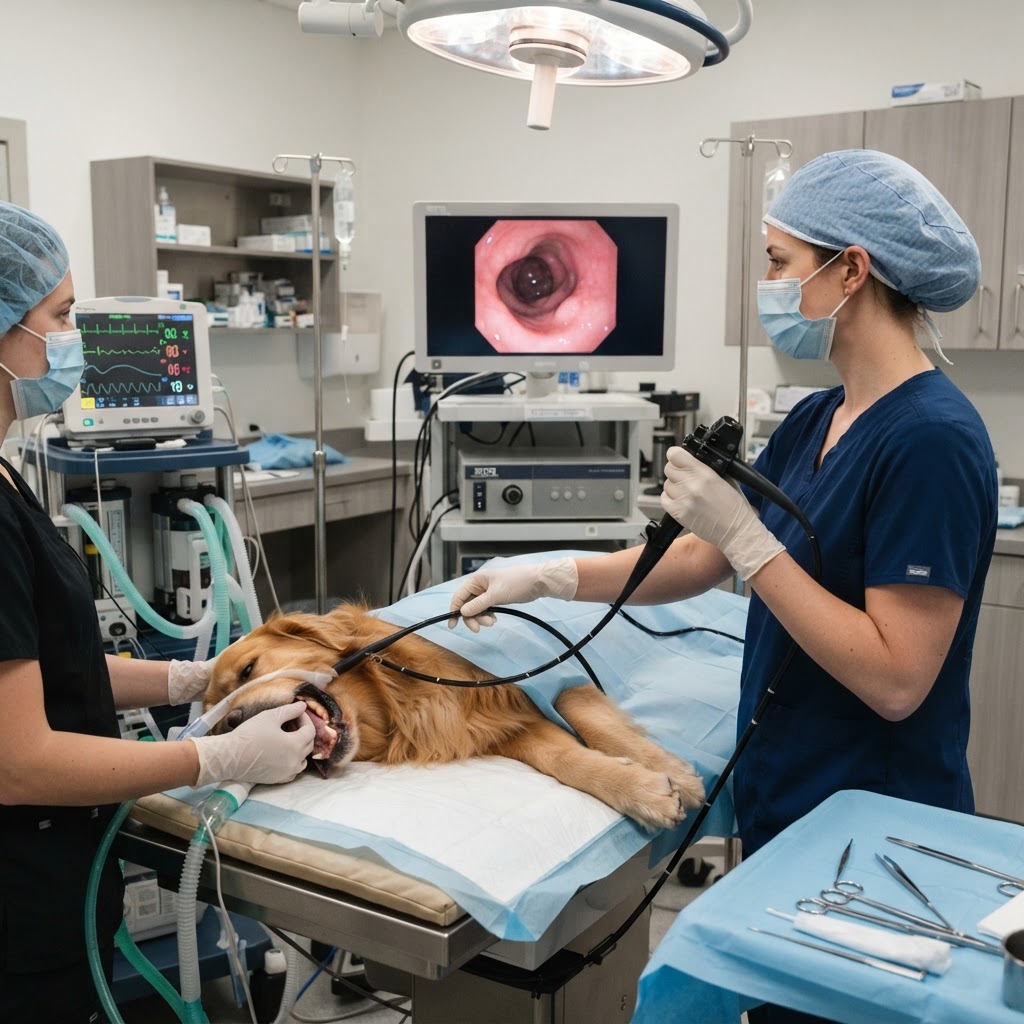
Endoscopy is a minimally invasive procedure that uses a flexible tube with a camera (endoscope) to examine your dog's gastrointestinal tract, respiratory system, or nasal passages. It can diagnose and sometimes treat conditions without the need for open surgery — including removing swallowed objects from the stomach.
The average cost of a dog endoscopy is $1,500, with most owners paying between $800 and $2,500 depending on the type and complexity.
Dog Endoscopy Cost by Type
| Endoscopy Type | Cost Range | Average | What It Examines |
|---|---|---|---|
| Gastrointestinal (GI) endoscopy | $800–$2,500 | $1,500 | Esophagus, stomach, duodenum — chronic vomiting, diarrhea, foreign bodies |
| Colonoscopy (lower GI) | $800–$2,000 | $1,400 | Colon — chronic diarrhea with blood/mucus, colon cancer screening |
| Rhinoscopy (nasal) | $800–$2,000 | $1,400 | Nasal passages — chronic nasal discharge, nosebleeds, nasal tumors |
| Bronchoscopy (respiratory) | $1,000–$2,500 | $1,750 | Trachea and bronchi — chronic cough, respiratory disease |
| Foreign body retrieval (GI endoscopy) | $1,200–$3,000 | $2,000 | Remove swallowed objects from stomach — avoids surgery |
| Upper + lower GI (combined) | $1,500–$3,500 | $2,500 | Both upper and lower GI tract — comprehensive evaluation |
Cost Breakdown
| Component | Cost |
|---|---|
| Consultation | $100–$200 |
| Pre-anesthetic blood work | $80–$200 |
| Anesthesia + monitoring (general anesthesia required) | $200–$500 |
| Endoscopy procedure | $500–$1,500 |
| Biopsy (if tissue samples taken) | $100–$250 |
| Histopathology (biopsy lab analysis) | $120–$350 |
| Cytology (if brush/wash samples taken) | $80–$150 |
| Recovery monitoring | $100–$200 |
| Total | $1,280–$3,350 |
When Does Your Dog Need Endoscopy?
- Chronic vomiting or diarrhea: When bloodwork, X-rays, and ultrasound don't reveal the cause
- Suspected foreign body: Dog swallowed something — endoscopy can retrieve it from the stomach without surgery
- Chronic nasal discharge: Rhinoscopy to examine nasal passages and take biopsies
- Chronic cough: Bronchoscopy to evaluate airways and collect wash samples
- Gastrointestinal cancer screening: Biopsy of stomach or intestinal lining to check for lymphoma, adenocarcinoma
- Diagnosis of IBD: Biopsy of intestinal lining to confirm inflammatory bowel disease
- Evaluation of esophageal strictures: Narrowing of the esophagus causing regurgitation
Endoscopy vs. Surgery — Which Is Better?
| Factor | Endoscopy | Exploratory Surgery (Laparotomy) |
|---|---|---|
| Cost | $800–$2,500 | $2,000–$5,000+ |
| Invasiveness | Minimally invasive — no incision | Surgical incision through abdomen |
| Recovery | Same day — home in a few hours | 3–7 days hospitalization + recovery |
| Can retrieve foreign bodies? | Yes (from stomach) — if small enough | Yes (any location) — if in intestines |
| Can examine entire GI tract? | Stomach + upper intestines only | Entire abdomen — all organs |
| Biopsy quality | Superficial (mucosa only) | Full thickness — deeper tissue |
| Complication risk | Low | Moderate (incision, infection risk) |
Endoscopy is preferred when the problem is likely in the stomach or upper intestines, when foreign body retrieval is the goal, or when the dog is a poor surgical candidate. Surgery is needed when the problem is in the lower intestines, when full-thickness biopsies are needed, or when the entire abdomen needs examination.
Frequently Asked Questions
How much does a dog endoscopy cost?
A dog endoscopy costs $800 to $2,500, with an average of $1,500. GI endoscopy costs $800–$2,500. Foreign body retrieval costs $1,200–$3,000. Total including consultation, blood work, anesthesia, endoscopy, biopsy, and pathology is $1,280–$3,350.
Does pet insurance cover dog endoscopy?
Yes, most pet insurance covers endoscopy when medically necessary — for chronic GI issues, foreign body retrieval, cancer diagnosis, or nasal/respiratory evaluation. Reimbursement is 70–90% after your deductible.
Can endoscopy replace surgery for foreign body removal?
It depends. If the object is in the stomach and small enough to fit through the endoscope channel, endoscopy can retrieve it without surgery (saving $1,000–$3,000 vs. surgery). If the object has passed into the intestines, is too large, or has caused perforation, surgery is required. Your vet will determine which approach is appropriate based on X-rays and location of the object.
How long does a dog endoscopy take?
The procedure takes 30–60 minutes. Your dog will be at the hospital for 4–6 hours total (check-in, anesthesia, procedure, recovery). Most dogs go home the same day — no overnight stay needed unless complications arise or biopsies require monitoring.