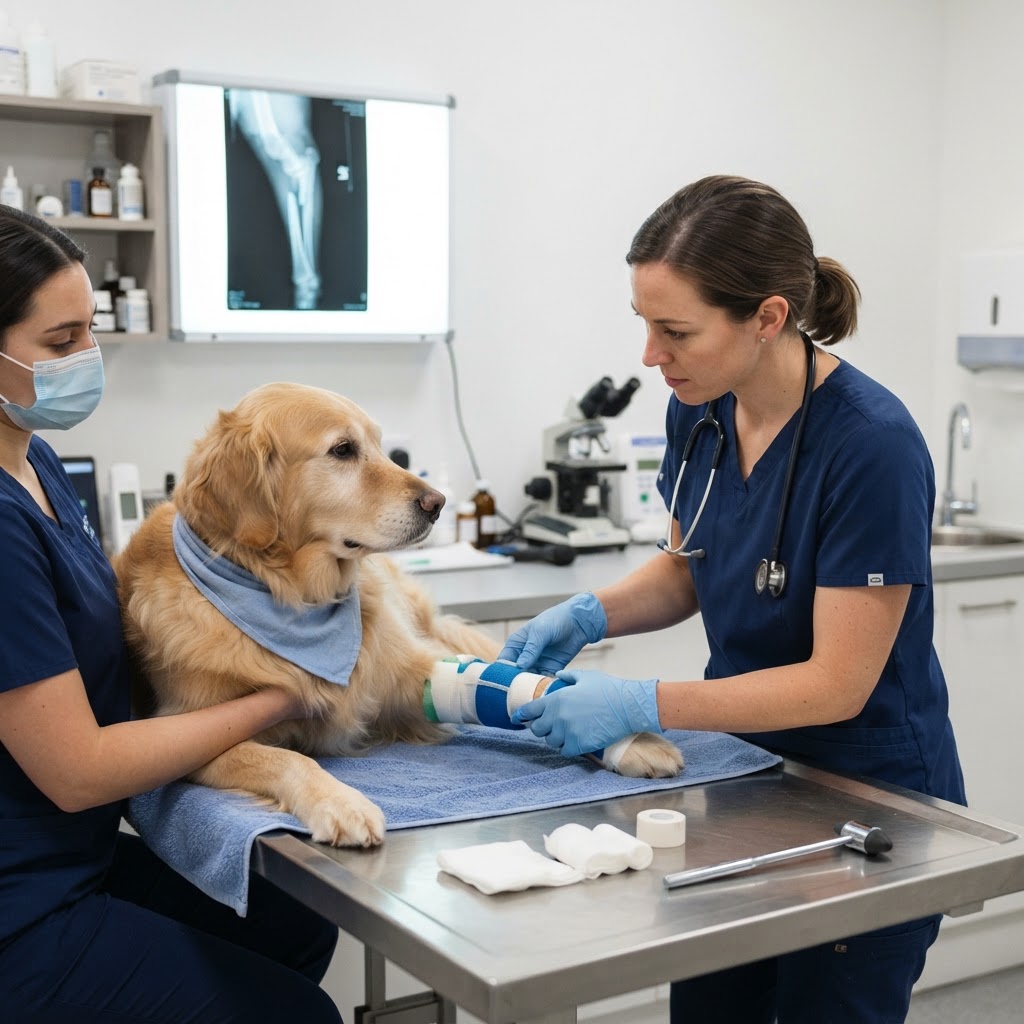
Bone cancer (osteosarcoma) is the most common type of primary bone cancer in dogs, affecting over 10,000 dogs annually in the US. It's aggressive, painful, and most commonly affects large breeds like Great Danes, Rottweilers, and Irish Wolfhounds. The primary treatment is surgery — usually amputation — followed by chemotherapy.
The cost of dog bone cancer surgery ranges from $1,000 for a simple amputation to $6,000+ for limb-sparing surgery, with the national average being $2,500–$4,000 for amputation alone.
How Much Does Dog Bone Cancer Surgery Cost?
| Procedure | Cost Range | Average | When Used |
|---|---|---|---|
| Amputation (forelimb) | $1,000–$3,000 | $2,000 | Most common treatment for osteosarcoma |
| Amputation (hindlimb) | $1,200–$3,500 | $2,200 | Slightly more complex than forelimb |
| Limb-sparing surgery | $4,000–$6,000+ | $5,000 | Alternative to amputation for lower leg tumors |
| Stereoradiation (stereotactic radiosurgery) | $8,000–$12,000 | $10,000 | Non-surgical alternative for some tumors |
Total Bone Cancer Treatment Cost
Surgery is just one part of the cost. Here's what the full treatment pathway typically looks like:
| Treatment Stage | Cost | Required? |
|---|---|---|
| Diagnosis (X-rays, biopsy, blood work) | $500–$1,500 | Yes — confirms osteosarcoma |
| Chest X-rays / CT (check for lung metastasis) | $300–$1,500 | Yes — 90% have microscopic spread at diagnosis |
| Amputation surgery | $1,000–$3,500 | Yes — removes the painful tumor |
| Histopathology (confirm diagnosis + grade) | $120–$350 | Yes |
| Overnight hospitalization | $200–$500/night | 1–3 nights |
| Take-home pain medication | $40–$100 | Yes |
| Chemotherapy (4–6 sessions, carboplatin) | $150–$600/session | Recommended — extends survival from 4 to 12 months |
| Palliative radiation (if surgery not possible) | $1,500–$3,000 | Alternative pain management |
| Total Cost (Surgery + Chemo) | $3,000–$8,000 |
Cost by Clinic Type
| Clinic Type | Amputation | Limb-Sparing Surgery |
|---|---|---|
| General practice vet | $1,000–$2,500 | Not offered |
| Board-certified surgeon | $1,500–$3,500 | $4,000–$6,000+ |
| Oncology specialty center | $2,000–$4,000 | $5,000–$7,000 |
| Teaching hospital | $1,000–$2,500 | $3,000–$5,000 |
Amputation vs. Limb-Sparing Surgery
Both options provide the same survival time when combined with chemotherapy. Amputation is much cheaper and has fewer complications. Limb-sparing surgery is an option for owners who strongly prefer to keep the limb, but it costs 2–3x more and has higher complication rates.
| Factor | Amputation | Limb-Sparing Surgery |
|---|---|---|
| Cost | $1,000–$3,500 | $4,000–$6,000+ |
| Best for | Any bone cancer location | Lower leg (distal radius/ulna) only |
| Surgery time | 1–2 hours | 3–5 hours |
| Recovery | 2–4 weeks | 8–12 weeks |
| Outcome | Complete tumor removal | Tumor removed, limb preserved |
| Complication rate | Low (5–10%) | Higher (20–40%) — implant issues, infection |
| Survival time (with chemo) | 10–14 months | 10–14 months (same) |
Frequently Asked Questions
How much does bone cancer surgery cost for a dog?
Dog bone cancer (osteosarcoma) surgery costs $1,000 to $6,000+. Amputation (the most common treatment) costs $1,000–$3,500. Limb-sparing surgery costs $4,000–$6,000+. Total treatment including chemotherapy runs $3,000–$8,000.
Does pet insurance cover bone cancer surgery and treatment?
Yes, most pet insurance policies cover bone cancer surgery, chemotherapy, radiation, and diagnostics. Reimbursement is typically 70–90% after your deductible. Pre-existing conditions are excluded, so enroll before any signs of cancer appear.
How long do dogs live after bone cancer surgery?
With amputation alone, median survival is 4–5 months. With amputation plus chemotherapy (carboplatin), median survival extends to 10–14 months. Unfortunately, osteosarcoma is aggressive and 90% of dogs have microscopic metastasis at diagnosis. Chemotherapy targets these spread cells.
Can a dog walk on three legs after amputation?
Yes. Most dogs adapt to three legs within 2–4 weeks and live happy, active lives. Large breeds do particularly well. The main concern with amputation is the underlying cancer, not the loss of the limb.
Is limb-sparing surgery better than amputation?
Both provide the same survival time when combined with chemotherapy. Limb-sparing surgery preserves the limb but costs 2–3x more ($4,000–$6,000 vs. $1,000–$3,500) and has higher complication rates (20–40% vs. 5–10%). Most oncologists recommend amputation as the standard treatment.