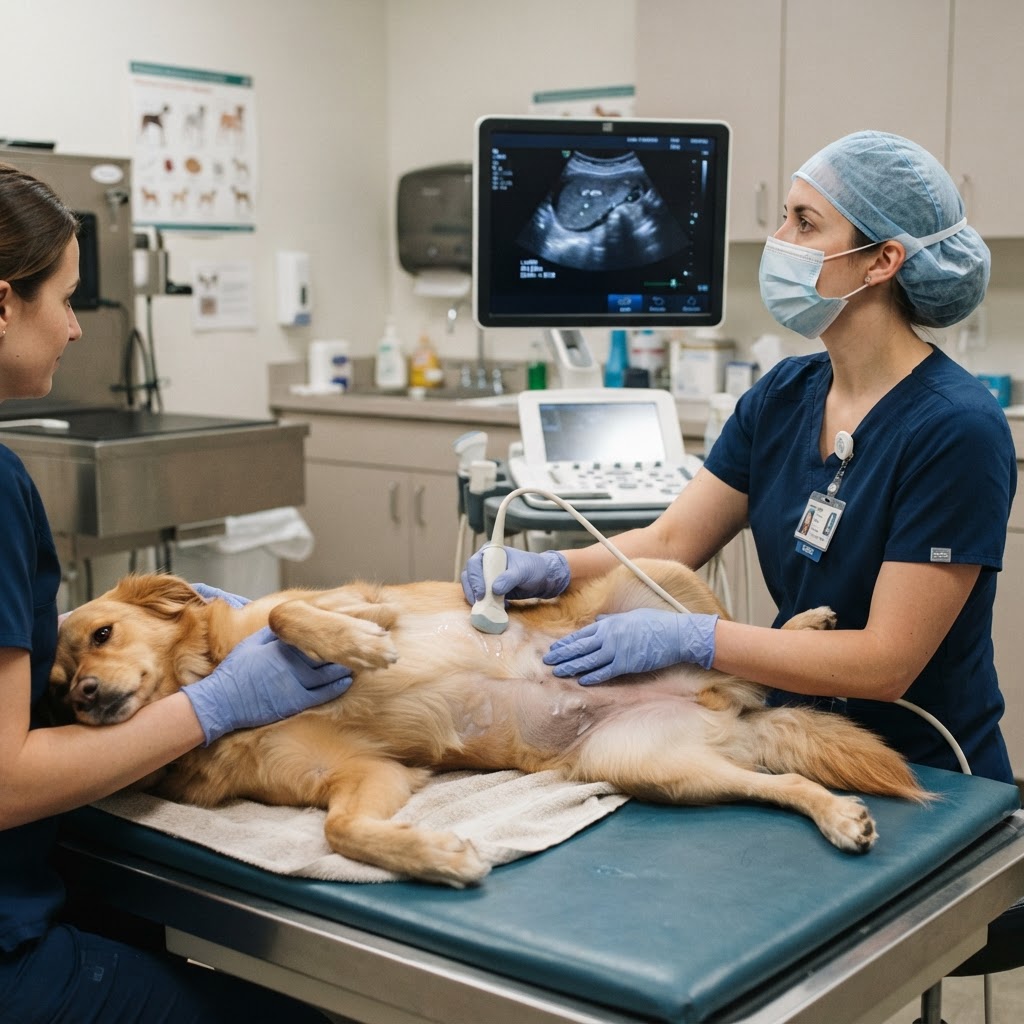
Ultrasound uses sound waves to create real-time images of your dog's internal organs. Unlike X-rays which show bones and outlines, ultrasound shows soft tissue detail, blood flow, and organ function. It's non-invasive, painless, and usually doesn't require sedation.
The average cost of a dog ultrasound is $500, with most owners paying between $350 and $1,000 depending on the scan type and facility.
Dog Ultrasound Cost by Type
| Scan Type | Cost Range | Average | What It Evaluates |
|---|---|---|---|
| Abdominal ultrasound (complete) | $350–$600 | $500 | All abdominal organs — liver, kidneys, spleen, bladder, intestines |
| Cardiac ultrasound (echocardiogram) | $500–$1,000 | $700 | Heart structure and function — performed by cardiologist |
| Pregnancy ultrasound | $300–$500 | $400 | Confirm pregnancy, check fetal viability (after day 25) |
| FAST scan (Focused Assessment with Sonography for Trauma) | $200–$400 | $300 | Quick check for internal bleeding after trauma |
| Bladder ultrasound (focused) | $200–$400 | $300 | Check for bladder stones, tumors, wall thickness |
| Ultrasound-guided biopsy (aspiration) | $400–$800 | $600 | Ultrasound used to guide needle biopsy of organs or masses |
| Eye ultrasound (ocular) | $300–$500 | $400 | Eye conditions when the retina can't be examined visually |
Cost Breakdown
| Component | Cost |
|---|---|
| Exam/consultation | $50–$150 |
| Abdominal ultrasound scan | $300–$500 |
| Sedation (if needed — not always required) | $50–$150 |
| Ultrasound gel + supplies | $20–$50 |
| Radiologist interpretation (if not done by specialist) | $100–$300 |
| Ultrasound-guided FNA (fine needle aspirate) if performed | $100–$250 |
| Cytology (if aspirate performed) | $80–$200 |
| Total (abdominal ultrasound) | $570–$1,400 |
Cost by Clinic Type
| Clinic Type | Abdominal | Cardiac (Echo) |
|---|---|---|
| General practice vet (with ultrasound) | $350–$500 | $500–$700 |
| Board-certified radiologist | $500–$700 | $700–$1,000 |
| Board-certified cardiologist (echo) | N/A | $800–$1,200 |
| Emergency hospital | $400–$800 | $600–$1,000 |
| Teaching hospital | $250–$400 | $400–$600 |
What Dog Ultrasound Detects
- Abdominal masses and tumors: Spleen, liver, kidney, intestinal tumors
- Bladder stones and tumors: Bladder stones, polyps, transitional cell carcinoma
- Organ enlargement: Liver, spleen, kidney enlargement
- Heart disease: Valve disease, heart enlargement, fluid around heart
- Pregnancy: Confirm pregnancy, count puppies, check viability
- Internal bleeding: FAST scan after trauma
- Gastrointestinal issues: Intestinal wall thickening, foreign body detection
- Guided biopsy: Safe sampling of internal organs and masses
Frequently Asked Questions
How much does a dog ultrasound cost?
A dog ultrasound costs $350 to $1,000, with an average of $500. Abdominal ultrasound costs $350–$600. Cardiac ultrasound (echocardiogram) costs $500–$1,000. Pregnancy ultrasound costs $300–$500. Total including exam, scan, and interpretation is $570–$1,400 for abdominal ultrasound.
Does pet insurance cover dog ultrasound?
Yes, most pet insurance covers ultrasound when it's medically necessary — to diagnose illness, cancer staging, or evaluate organ function. Reimbursement is 70–90% after your deductible. Routine pregnancy ultrasound may not be covered unless medically necessary.
Does my dog need sedation for an ultrasound?
Usually no. Most abdominal ultrasounds are done without sedation. The dog lies on their back while the vet shaves a small area and applies gel. Some dogs who are very anxious, in pain, or won't hold still may need light sedation ($50–$150). Cardiac ultrasounds typically don't require sedation.
Ultrasound vs. X-ray — which is better?
X-rays ($75–$500) show bones, organ outlines, and foreign bodies but can't see inside organs. Ultrasound ($350–$1,000) shows soft tissue detail, blood flow, and organ architecture but can't see through bone or gas. They're complementary — many cases need both. X-rays are cheaper and faster; ultrasound provides more soft tissue detail.