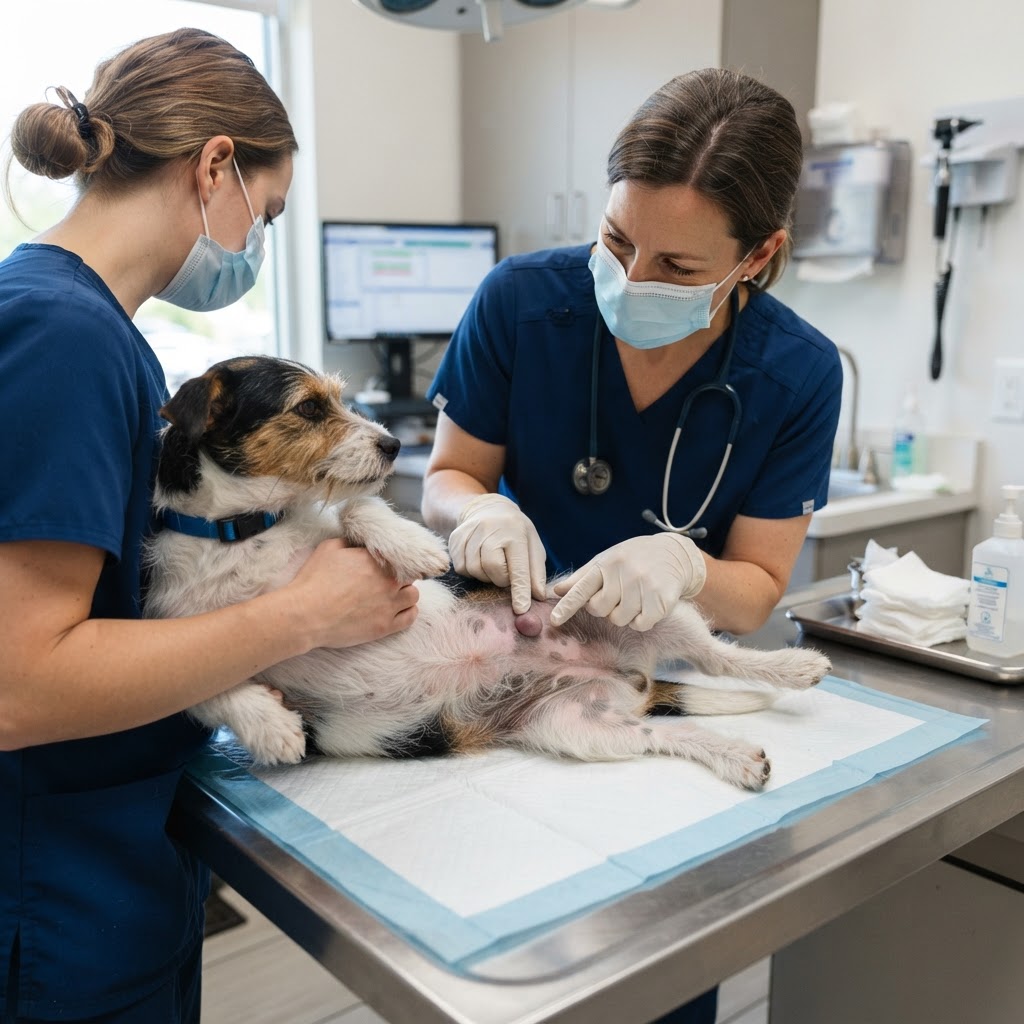
Hernias occur when an internal organ or tissue pushes through a weak spot in the muscle wall. In dogs, hernias can be congenital (present at birth) or acquired (from trauma or strain). Some hernias are harmless and can be monitored; others require immediate surgery to prevent life-threatening complications.
The cost of dog hernia surgery ranges widely — from $150 for a simple umbilical hernia repair to $10,000+ for complex diaphragmatic hernia repair. The national average is $1,500.
Dog Hernia Surgery Cost by Type
| Hernia Type | Cost Range | Average | Urgency |
|---|---|---|---|
| Umbilical (belly button) | $150–$700 | $400 | Elective — can monitor if small |
| Inguinal (groin) | $500–$2,500 | $1,200 | Semi-elective — surgery recommended |
| Perineal (rear end) | $1,500–$5,000 | $3,000 | Semi-elective — can become emergency |
| Diaphragmatic (chest cavity) | $2,500–$10,000+ | $5,000 | Emergency if acquired (trauma) |
| Hiatal (stomach through diaphragm) | $2,000–$6,000 | $4,000 | Semi-elective — medical management tried first |
| Cat hernia surgery | $150–$2,000 | $800 | Varies by type |
What Is Each Type of Hernia?
The most common type in puppies. A small bump at the belly button where abdominal fat or tissue pushes through the umbilical ring. Most are small and harmless — many close on their own by 6 months of age. Surgery is recommended if the hernia is large (>1cm), growing, or hasn't closed by adulthood. Cost: $150–$700.
A bulge in the groin area where abdominal tissue pushes through the inguinal ring. More common in female dogs (especially pregnant or middle-aged). Can be dangerous if intestines become trapped (strangulated). Surgery is recommended to prevent complications. Cost: $500–$2,500.
A bulge next to the anus where pelvic organs (bladder, rectum, prostate) push through the pelvic floor muscles. Most common in intact male dogs over 7 years old. Can become life-threatening if the bladder is trapped. Surgery is complex and should be done by an experienced surgeon. Cost: $1,500–$5,000.
A tear in the diaphragm (the muscle separating chest and abdomen) allows abdominal organs to push into the chest cavity, compressing the lungs and heart. Usually caused by trauma (car accidents, falls). This is a life-threatening emergency requiring immediate surgery. Cost: $2,500–$10,000+.
Cost Breakdown
| Component | Cost |
|---|---|
| Exam + diagnostics (X-rays, ultrasound) | $150–$500 |
| Pre-surgical blood work | $80–$200 |
| Anesthesia + monitoring | $150–$400 |
| Hernia repair surgery | $150–$10,000 (varies by type) |
| Surgical mesh (if needed for large defects) | $100–$500 |
| Overnight hospitalization | $200–$500/night |
| Take-home pain medication + antibiotics | $40–$100 |
| Follow-up visit | $50–$150 |
Cost by Clinic Type
| Clinic Type | Simple (Umbilical) | Complex (Perineal/Diaphragmatic) |
|---|---|---|
| General practice vet | $150–$500 | Usually referred to specialist |
| Board-certified surgeon | $300–$700 | $2,500–$7,000 |
| Emergency hospital | $400–$800 | $3,500–$10,000+ |
| Teaching hospital | $200–$400 | $1,500–$5,000 |
Frequently Asked Questions
How much does dog hernia surgery cost?
Dog hernia surgery costs $150 to $10,000+ depending on the type. Simple umbilical hernia repair costs $150–$700. Inguinal hernia costs $500–$2,500. Perineal hernia costs $1,500–$5,000. Diaphragmatic hernia (emergency) costs $2,500–$10,000+. The national average is $1,500.
Does my dog need hernia surgery?
Small umbilical hernias (under 1cm) may close on their own and can be monitored. Larger hernias, inguinal hernias, perineal hernias, and all traumatic (acquired) hernias require surgery. If you can push the hernia back in, it's "reducible" but still needs repair. If it can't be pushed back and is painful, it may be strangulated — seek emergency care immediately.
Can a hernia be left untreated?
Small, reducible umbilical hernias can sometimes be monitored without surgery. However, all other types should be repaired. Untreated hernias can lead to organ strangulation (blood supply cut off), which is life-threatening. The risk increases over time as the hernia opening may enlarge.
Does pet insurance cover hernia surgery?
Coverage depends on whether the hernia is congenital or acquired. Congenital hernias (present at birth, like many umbilical hernias) may be considered pre-existing if diagnosed before enrollment. Acquired hernias (from trauma) are typically covered. Reimbursement is 70–90% after your deductible for covered procedures.
Can umbilical hernia be fixed during spay/neuter?
Yes. If your puppy has an umbilical hernia, it can often be repaired at the same time as spay or neuter surgery. This saves on anesthesia costs and is a common practice. The additional cost is usually $50–$200 on top of the spay/neuter fee.